Thursday, June 14, 2007

General Leopoldo Galtieri and the Invasion of the Falklands

Today marks the 25th anniversary of the end of the Falklands War.

When the war was declared, Argentina was one of those countries that had long suffered leaders who assiduously snatched poverty out of the jaws of prosperity. In 1933 Argentina had been the ninth most prosperous country in the world, to which immigrants from Europe, and in particular Italy, flocked in great number. After the Second World War, Argentina fell in the thrall of Juan Perón, whose catastrophic mixture of cronyism and corporatism left Argentina an economic and political basket case. Nor did his hospitality towards people one could euphemistically describe as "political refugees" from postwar Europe endear him to the wider world.

Perón's last wife, whose life was not made into a famous London musical, succeeded him to the presidency of an Argentina plagued by left-wingers given to the notion that it was justified, even ethical, to summarily kill purported "enemies of the revolution," and a military that had no compunctions about "disappearing" thousands of revolutionaries known to entertain such beliefs, or suspected of doing so, without worrying about legal niceties. Such circumstances rarely make for too happy a country; as General Leopoldo Galtieri, the head of the junta that held the reigns of power in Argentina, realized that time was running out for his increasingly unpopular regime, he decided to invade the Falkland Islands.

The Falklands had belonged to Spain, and been part of the Spanish province to which Argentina belonged when Argentina declared its independence from Spain in 1816. In 1833, the British occupied the Falklands, deported the remaining Argentines, and settled some of Her Majesty's Subjects on the islands. Argentina had never - and does not - recognize the British claim to these islands; to this day it remains a matter of national pride that the "Malvinas" as they are known in Spanish, are Argentinian.

General Galtieri believed - or wanted to believe - that the British under Maggie Thatcher's leadership, would quietly acquiesce to his conquest, and that the United States, with whom he enjoyed a good working relationship based on their mutual enmity of Communism, would put its friendship with Argentina above its venerable, almost fraternal, ties with Great Britain. In both of these he was sorely mistaken; Argentina's forces on the Falklands were no match for the British forces. The Falklands were lost, and his government fell. The talks between the United Kingdom and Argentina about the future of the islands - however soporific they may have been - are also a thing of the past.

But for the few days or weeks in which it seemed that Argentina may have regained the Malvinas, General Leopoldo Galtieri was the talk of the town.

AddThis Social Bookmark Button

Saturday, June 9, 2007

Justice


I
n medieval Europe, towns were the seat of government, site of markets, and seat of the courts. Not coincidentally, many towns would have drinking fountains adorned with allegories of justice, presumably near where the courthouses were. Note how this particular allegory of justice is not only blind-folded, but, by modern standards for models, remarkably portly. Times change, and so do fashions. In which age, do you think, were models healthier?

AddThis Social Bookmark Button


Wednesday, June 6, 2007

Sir Wilfred Thesiger: Explorer, Friend of Ethiopia, and Refugee from Modernity

After I posted this article, I learned that the Pitt River Museum at Oxford owns the rights to Thesiger's photographs. Rather than purchase a license for £350 (about $500,) Ie decided to remove the pictures, and offer my readers hyperlinks to the pictures. They are worth the time.

O
ne of the men who has long fascinated me, because he was a very interesting person with an even more interesting life was Sir Wilfred Thesiger. Click here for the first picture.

Probably the last of the great explorers that the British Empire produced, Thesiger's life is interesting not only for the places he explored and the events he witnessed, but also because of the lessons Thesiger drew. Thesiger understood that there was no stopping the course of history and technological progress. But he never made his peace with modernity; for him motorcar and aeroplane, and even more so poison gas and nuclear weapons, were epithets. He spent most of his life living with "backward" tribes in remote parts of the world; it was not until Parkinson's got the better of him that he left his dwellings in a remote part of Kenya to return to England.


Thesiger was born in one of the thatched-roof huts (click here for a picture) that then constituted the British legation in Addis Ababa, the capital of what was then Abyssinia, where his father, a seasoned diplomat, was the British Consul General. His family was part of the British aristocracy; his uncle was the Viceroy of India and a Viscount, his grandfather had been a general and the second Baron Chelmsford. When Thesiger was born, Ethiopia, then known as Abyssinia, was the only African country to never have been colonized, and far and away the country south of the Sahara with the richest and most interesting history.

Ethiopia's is mentioned in Greek and perhaps Egyptian chronicles; Flavius Josephus, a Jewish historian and near contemporary of Christ, mentions that the Queen of Sheba with whom King Solomon enjoyed a friendship, and in the Ethiopian tradition a relationship, was from Ethiopia. Until the 1980s, Ethiopia had a fair sized Jewish community that traced its roots back to King Solomon. The Acts of the Apostles in New Testament tells of a visit by by the an official of the Queen Candace of Ethiopia to the Holy Land, who met Philip the Evangelist. 100 years before Saint Patrick sailed for Ireland, Ethiopia adopted the Coptic form of Christianity. When Islam arose, the Ethiopians sacked Jeddah, and then, when the Muslims counterattacked, lost their cities on the Red Sea. The neighboring countries were overran by Islam, Ethiopia, like Tibet, another country on a plateau, was able to resist the new religion; Somalia, the Sudan, Egypt and to some degree Kenya didn't. Gibbon's memorable summary was: "Encompassed on all sides by the enemies of their religion, the Aethiopians slept near a thousand years, forgetful of the world, by whom they were forgotten."

Click here for the next picture.


In the fifteenth century, when the Portuguese became a naval power and established their colonies from Goa to Macao and points in between, they came into contact with the Ethiopians. The Ethiopians had just suffered a major defeat to the Turks, in a battle in which the Turks introduced the flintlock to Ethiopia. The Ethiopians looked to the Portuguese, their fellow Christians, for help, which came in the form of an expedition under Christopher da Gama, son of Vasco da Gama. Much as in the story of Matteo Ricci, for a while things went quite well. The Jesuits who came to Ethiopia with the Portuguese quickly gained influence at the Ethiopian court, but personality and theological (Copts are monophysites loyal to the Patriarch of Alexandria, Catholics were neither) conflicts led to their being expelled. They left traces; when Thesiger began to explore those parts of Ethiopia that had never before been explored by Europeans, there were instances where he had to confess in his memoirs, much to his chagrin, that in the sixteenth century, a Jesuit father by the name of so and so had indeed been there, but never since had a European returned.

Click here for the next picture.

For the purposes of discussing Thesiger's life, and his love of Ethiopia, we can move forward to the reign of Emperor Menelik II, during whose reign Thesiger and his family moved to Ethiopia. Menelik was the first modern African head of states to defeat a European army in the field; the Italians, late in the scramble for Africa, had sought to make a "protectorate" of Ethiopia. Menelik declined the questionable honor, and at the Battle of Adowa in 1896, his men resoundingly defeated the invading Italian army, in what was a truly humiliating defeat for the Italians. Mussolini, who was expelled from school for knifing a fellow student - a priest who taught him told him that he had a heart "black as sin" - would never forgive the Ethiopians for doing so, and order his thugs in uniform to use poison gas to ensure that they would prevail on the field of battle.

One of Thesiger's memories from his time in Ethiopia was of Ethiopian civil war of 1916. Of the three Central Powers, the Ottoman Empire was Muslim, in fact the Ottoman Sultan would intermittently claim to be the Caliph, or highest authority, of Sunni Islam. The Germans adopted the shameful ruse of war of suggesting to the Muslim peoples under British rule that the Kaiser had secretly converted to Islam, and that they ought make common cause with the Germans for this reason. At the time, the British were fighting the Germans and Ottomans in several countries near Ethiopia, among them Kenya, Somalia, Yemen, Palestine, and Syria. Probably under Turkish and German influence, and convinced after the British defeats at Kut and Gallipoli that the Central Powers would probably win, Liy Yasu, the Emperor of Ethiopia all but converted to Islam, and was quickly deposed by the Ethiopian church and nobility, Ras (Prince) Tafari, later known as Haile Selassie, was installed as the new regent, Empress Zaitu remained as the empress.

A civil war erupted, and was quickly put down. At the end of this war, Haile Selassie and his soldiers were accorded a triumph through Addis Abeba which Thesiger described:

Huge tents, open-fronted, had been put up and the Empress came in state with all her ladies, veiled to the eyes, add took her place on the throne. We were presented and Billy and Brian shook hands. All the local army was ranged up on either side and in front, the chiefs a mass of colour, with their gold-embroidered robes and jewelled crowns and shields, the lesser chiefs in lion- or leopard- skins or sheep-skins dyed in brilliant colors. About 10:30 am, the army began to march past. First came the ministrels, yelling war songs, and when they had finished they tore off their mantles and threw them down before the Empress, saying now that they had fought for her such clothes were no longer worthy of them and would she give them new ones? On these occasions every freedom of speech is allowed. The advance guard of men on mules and horses came up in regular lines but as soon as they got near they dashed up at full gallop, shouting and brandishing their weapons, each men shrieking out how many men he had killed; and then they wheeled round to make room for others....

The whole description takes up two pages of his autobiography, which is currently out of print. But that is what used book stores are for. Thesiger concludes his reminiscencing:

"I believe that day implanted in me a life-long craving for barbaric splendour, for savagery and colour and the throb of drums, and that it gave me a lasting veneration for long-established custom and ritual, from which would derive later a deep-seated resentment of Western innovation in other lands, and a distaste for the drab uniformity of the modern world."


After the First World War ended, and travel once again became safe, Thesiger left for boarding school in England, then for Eton and Magdalen College, Oxford, where he excelled more as a boxer than a scholar. After he graduated from Oxford, he spent a year leading an expedition that explored parts of Ethiopia that no European had yet traversed or mapped. Parts of his expedition took him into the lands inhabited by a tribe then known as a Danakil, amongst whose menfolk, the number of men a man had killed and then emasculated for trophies was the primary indicator of status. Although Emperor Haile Selassie, his life-long friend, (the two are in the picture at this link) had given him permission to embark on his trek, the local governor insisted that Thesiger indemnify him before setting off for the the wilderness. After the trek, he joined the Sudanese colonial service in Darfur.

Thesiger was greatly disappointed when the British politicians of the 1930s assented to Mussolini's invasion of Ethiopia, in the vain and foolish hope that to not condemn the invasion, and the routine use of poison gas, would help keep Mussolini from making common cause with Hitler, and avoid war in Europe. Mussolini's attitude to the war was such that he ordered his soldiers to not only use poison gas and flame-throwers liberally but also to employ "bacteriological warfare," only to be told that the last was impractical. When Addis Abeba fell, the Blackshirts went through the city "liquidating" educated Ethiopians. Thesiger later wrote of his satisfaction when he learned that Mussolini had been put to death by his own people, and "appropriately" hung on a meat hook.

Another reason for the British reticence may have been that the British themselves were using poison gas to quell the rebellious Iraqi tribes at the time. Pots and kettles have their own etiquette. The British ignored their obligations under a treaty to sell Ethiopia weaponry, and even denied, contrary to all evidence, that Italy was using poison gas, and turned a blind eye to a war that was more annihilation than a good war. When all was lost, Haile Selassie went on a pilgrimage to Ethiopia's national shrine, prayed there for two days, and then traveled on to Geneva to give a haunting speech, in Amharic, at the League of Nations, in which he informed the other nations that if they abandoned the Covenant of League of Nations, which required that all disputes be settled by diplomacy rather than war, they, too, would reap the whirlwind. And indeed they did. His eloquence, once the galleries had been cleared of Italian agitators paid to disrupt his speech, was such that he was made Time magazine's Man of the Year. Here's a pathos-filled picture of His Imperial Highness during the speech. And here's the beginning of the speech:

"I, Haile Selassie I, Emperor of Ethiopia, am here today to claim that justice which is due to my people, and the assistance promised to it eight months ago, when fifty nations asserted that aggression had been committed in violation of international treaties.

There is no precedent for a Head of State himself speaking in this assembly. But there is also no precedent for a people being victim of such injustice and being at present threatened by abandonment to its aggressor. Also, there has never before been an example of any Government proceeding to the systematic extermination of a nation by barbarous means, in violation of the most solemn promises made by the nations of the earth that there should not be used against innocent human beings the terrible poison of harmful gases. It is to defend a people struggling for its age-old independence that the head of the Ethiopian Empire has come to Geneva to fulfil this supreme duty, after having himself fought at the head of his armies.

I pray to Almighty God that He may spare nations the terrible sufferings that have just been inflicted on my people, and of which the chiefs who accompany me here have been the horrified witnesses.

It is my duty to inform the Governments assembled in Geneva, responsible as they are for the lives of millions of men, women and children, of the deadly peril which threatens them, by describing to them the fate which has been suffered by Ethiopia. It is not only upon warriors that the Italian Government has made war. It has above all attacked populations far removed from hostilities, in order to terrorize and exterminate them.

At the beginning, towards the end of 1935, Italian aircraft hurled upon my armies bombs of tear-gas. Their effects were but slight. The soldiers learned to scatter, waiting until the wind had rapidly dispersed the poisonous gases. The Italian aircraft then resorted to mustard gas. Barrels of liquid were hurled upon armed groups. But this means also was not effective; the liquid affected only a few soldiers, and barrels upon the ground were themselves a warning to troops and to the population of the danger.

It was at the time when the operations for the encircling of Makalle were taking place that the Italian command, fearing a rout, followed the procedure which it is now my duty to denounce to the world. Special sprayers were installed on board aircraft so that they could vaporize, over vast areas of territory, a fine, death-dealing rain. Groups of nine, fifteen, eighteen aircraft followed one another so that the fog issuing from them formed a continuous sheet. It was thus that, as from the end of January, 1936, soldiers, women, children, cattle, rivers, lakes and pastures were drenched continually with this deadly rain. In order to kill off systematically all living creatures, in order to more surely to poison waters and pastures, the Italian command made its aircraft pass over and over again. That was its chief method of warfare.

Ravage and Terror

The very refinement of barbarism consisted in carrying ravage and terror into the most densely populated parts of the territory, the points farthest removed from the scene of hostilities. The object was to scatter fear and death over a great part of the Ethiopian territory. These fearful tactics succeeded. Men and animals succumbed. The deadly rain that fell from the aircraft made all those whom it touched fly shrieking with pain. All those who drank the poisoned water or ate the infected food also succumbed in dreadful suffering. In tens of thousands, the victims of the Italian mustard gas fell. It is in order to denounce to the civilized world the tortures inflicted upon the Ethiopian people that I resolved to come to Geneva. None other than myself and my brave companions in arms could bring the League of Nations the undeniable proof. The appeals of my delegates addressed to the League of Nations had remained without any answer; my delegates had not been witnesses. That is why I decided to come myself to bear witness against the crime perpetrated against my people and give Europe a warning of the doom that awaits it, if it should bow before the accomplished fact."


When the Second World War was declared, Thesiger fought with the SAS, i.e. as a commando, in North Africa; once when he was on a mission behind enemies lines, he covered himself with sand when he heard German soldiers approach, looking for saboteurs. They came within 50 feet, but didn't see him; when Thesiger read Rommel's diary, it became clear to him that, given the time and location at which he barely escaped the German patrol, it had been Rommel himself who had been looking for saboteurs.

When the time came for the British to liberate Ethiopia from Mussolini's footmen, Thesiger served with valor and distinction, winning a DSO, and helping his life long friend Emperor Haile Selassie, Emperor to the Ethiopians, and god to the Rastafarians (Haile Selassie's pre-emperor name was Ras (prince) Tafari,) regain his throne. He then fought with the Druze in Lebanon. After the war, Thesiger went on to become one of the most noted explorers of our day, traveling to wilds of Afghanistan, Arabia, Iraq, Iran, Pakistan and Kenya. But that is for another post.


Links:

Wilfred Thesiger's picture collection at Pitt Rivers Museum

Haile Selassie's speech to the League of Nations, asking them why they abandoned his country to Mussolini.

AddThis Social Bookmark Button

Monday, May 21, 2007

Plato and Polybius, Saint Francis of Assisi, Richard the Lionheart, Emperor Frederick and "Eurabian" history


"Where there is charity and wisdom, there is neither fear nor ignorance. Where there is patience and humility, there is neither anger nor vexation. Where there is poverty and joy, there is neither greed nor avarice. Where there is peace and meditation, there is neither anxiety nor doubt."
The Counsels of the Holy Father St. Francis, Admonition 27


Political The
ory Today, and a Century Ago

In the days since the man HL Mencken referred to as the "Archangel Woodrow," re-elected on  his promises to "keep us out of the war," took it upon himself to impose an end to  senseless and stupid European family feuds, giving self-determination to those ethnicities who lost the war, but not to those whose governments who won the war, or perhaps more accurately had lost that bloodbath less badly, the Western understanding of the ideal form of government has radically changed.

Plato, a Greek philosopher known for his works on politics and laws, identified six different forms of regimes. He concluded that the ideal form of government was the rule of philosopher-kings, but that, human nature being what it is, humanity's lot is to go through cycles in which the weaknesses inherent in every form of government lead to its replacement by a different new form of government. (The inherent weaknesses were such that Plato concluded that the inevitable cycle was an ouroboros of political scientists.) Polybius went him one better, and suggested the idea of a "mixed regime" in which regimes try to counterbalance the different forms of governments in such a way that the various strengths of the different forms augment each other. Until 1917-18, the Western world was a lot closer to the rule by anointed philosopher kings than it is today. Europe had five empires (British, German, Habsburg, Ottoman, Russian,) sundry monarchies of various flavors, and a few republics, preeminent among them the French Republic.

France had oscillated between the most monarchical and most republican governments with an amazing frequency; consider Louis XIV roi soleil (absolute monarch), Louis XVI (guillotined liberalizing king), Robespierre (guillotined republican), Napoleon (exiled emperor), Charles X (exiled king), Louis-Philippe (deposed liberal king), Napoleon III (exiled emperor), the Third Republic (overthrown republic), the undemocratic Vichy Regime (overthrown authoritarian state), the fourth Republic (overthrown republic), de Gaulle (democracy led by a strong man), the Fifth Republic (democracy).  Canada was part of the British Empire, as were various islands such as Bermuda, Jamaica, and more.  England had gone through a republican phase, whose legacy lived on resentments in Ireland and Republicans in Massachusetts and the rest of the United States. In short, had you journeyed from San Francisco to Vladivostok the long way in 1912, the only unabashed republics whose soil you would have crossed would have been the United States and France.  Had you in 1914 been of the opinion that democracy was the only tolerable form of government, the most charitable response you would have elicited was that that the inevitable eccentrics who help define and enrich the human condition, like the amateur political scientists who in the 1990s concluded that the United States' annexation of Texas was legally invalid, and reestablished the Republic of Texas, elicit.


America's Mixed Regime


While the text books that American political scientists must consult during their periods of indoctrination unanimously and emphatically declaim that the United States is a constitutional republic, a closer look at American realities reveals that the American polity does have elements of a mixed regime. One of the most obvious was the fair city of Chicago under Mayor Daley the Elder, where rumor has it that the city elders extended the right to vote not only to the indigent and ignorant but also to the deceased, and even more graciously, to those who had already exercised their right to vote. "Vote early and vote often" they said. Things being as they were, His Honor was consistently reelected; today his son has the honor. This isn't to criticize the arrangement; part of the implicit bargain offered the electorate was that there never was even a whiff of corruption surrounding Mayor Daley personally, nor was there any doubt that Daley père was faithful to his wife. While some bewailed the somewhat undemocratic character of the Daley years, there is no doubt that Mayor Daley was correct in asserting that "We shall reach greater and greater platitudes of achievement:" today Chicago prospers while Detroit, St. Louis, and Cincinnati, which enjoyed more democratic forms of government, don't.


The Change in our Understanding of Regimes


Only after the rank folly that was the First World War, and the orgies of sadism that were Bolshevism and and National Socialism, did the consensus come to be that democracy was the best, or perhaps least unattractive, form of government. I rue not the end of those regimes that sent their men to die by the millions, in the name of "God and Country." The first obligation of any government is to the well-being of its people; any regime willing to sacrifice its youth for the careers and egos of its elders is illegitimate. One of the problems inherent in empires and monarchies is that if the emperor or king is a senile or demented and slaughters or abuses his subjects, there is not that much subjects can do to stop them. In France, on the other hand, after more than a million of France's twenty million men had fallen in the field, more than fifty divisions mutinied. More than 20,000 men were tried in courts martial; pictured is a ceremony pour encourager les autres. Nivelle, the French commander was replaced by a new commander unwilling to let the British and Americans fight the Germans to the last Frenchman, and the French army didn't involve itself in offensive operations for the next year. The same commander was retrieved from retirement and put into high office a second time in 1940, after the Maginot Line had fallen, and the French army been soundly beaten.

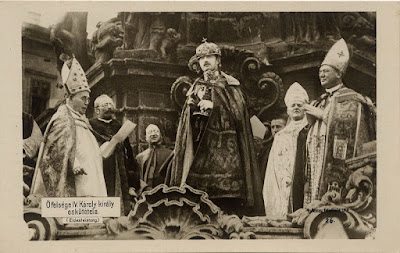
The only emperor, in fact the only political leader, who consistently sought to end the carnage that was World War One was Blessed Charles of Austria, who also happened to be the only statesman to regularly visit the soldiers fighting at the front.  He also was the only political leader in that war to forbid his armies to use poison gas. After the German army had made it clear it would not accept any peace proposal, he sought to reach a separate peace with the Allied Powers, alas without success. One of my heroes. Even noted socialists, not generally known for praising monarchs, have been known to publicly and unequivocally declare that Charles, Emperor of Austria, and King of Hungary (pictured above) was the only decent person to serve as head of state during those years of slaughter.

Divide et Impera! or How to Get and Stay Elected


One of the less pleasant aspects of a democracy is that it is generally easier to rally voters around shared hatreds that are often all too clear than around shared dreams, which by their very nature are also frequently somewhat vague. Witness the raw racism all too prevalent in the old Confederacy after its voters were deprived of their right to vote, and only the previously disenfranchised and carpet-baggers could vote. Witness the odious race-baiting that helped bring the National-Socialists to power; remember Bush père's Willie Horton advertisement with its racial overtones, etc, etc. This isn't to say that undemocratic forms of governments don't have their flaws - they certainly do - but that theirs are different; in some ways better, in some ways worse. For an ambitious and immoral politician the ideal bogeyman to wave in front of the electorate is one that inspires fear and loathing, and either doesn't exist, or can't fight back. Attacking adversaries who can't defend themselves is an old trick, but it is bogeymen who don't exist that are a demagogue's dream, for the simple reason that in politics solving any real problem requires compromises that entail expending political capital. Inventing, and then solving, non-existent problems allows demagogues to craft solutions that cost them no political capital but redound to their friends' benefit and usually their enrichment, while at the same time winning them the acclaim and gratitude of the dolts in the electorate, even though the remedy doesn't serve said dolts, and indeed usually is to their detriment.

There are many resentments that demagogues use in their attempts to forge coalitions; those of the left generally tend to incite hatred of the rich, the talented and the authorities, those of the right generally foster the hatred of the poor, slothful, untalented, and unfortunate. Another old standby, of which both the right and left have availed themselves, are racial animosities, spoken and unspoken, sometimes even disingenuously denied. It seems to me that some present day politicians have fallen to this temptation to campaign not against an enemy but rather an ethnicity or culture; the point of this long, perhaps somewhat ponderous, introduction is to write of leaders in earlier times who interacted with their Muslim enemies at a time when the "West," whatever that exactly is, was at war with the "infidel" or Muslim world.  Ideally I would supply my reader with copious footnotes, references, and further suggestions for reading; I can, alas, only offer but a bare outline of what I think is a fascinating topic.


Francis of Assisi and the Crusades


I trust that the basic outlines of Francis of Assisi's life are known to my
readers; the abandonment of a life of luxury for that of a mendicant friar, the founding of an order, and more.
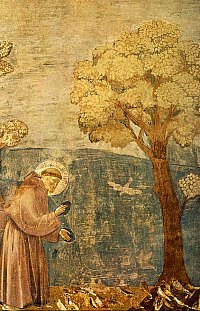
Fewer people are aware that Francis of Assisi thought that the Fifth Crusade was an unjust war, and that the only way to end the fighting was to convert the Muslim Sultan (commander) Al Kamil to Christianity by nonviolent means. To do so, he traveled to Egypt, and obtained very reluctant permission from Pelagius, the hapless Cardinal the Pope had charged with leading the crusade, for him to cross behind enemy lines and preach the Gospel, which Pelagius was sure would cost Francis his head. Francis went forth nonetheless, and soon found himself talking face to face with Al-Kamil, pleading for peace and explaining his faith. In Shari'a law proselytizing is a capital offense, and soon the Muslim theologians to whom Francis had explained his beliefs wanted to see him lose his head. Al Kamil, impressed by Francis's character and life of poverty, refused, telling Francis that it would be an injustice to punish him for what he clearly believed to be an act of charity performed at great risk to himself.

Nevertheless, Francis found himself unable to convert any Muslims and equally unable to end the war to which he was opposed. In fact, he would have liked to convert some of the crusaders, of whose attitudes he heartily disapproved, to Christianity. Pelagius unwisely turned down the offer of a cease-fire, and Francis decided it was time to travel on. Declining expensive farewell gifts from his friend Al-Kamil, which only further impressed Al-Kamil, he left for a pilgrimage to the Holy Land.


Richard Lionheart tries to Betroth his Sister to Saladin


Richard I, King of England, (1157-1199) was also known as Richard Cœur de Lion or Richard the Lionheart, was the son of Henry II and Eleanor of Acquitaine, one of the most memorable women of the Late Middle Ages, who had previously been married to Louis, King of France, until they were mercifully granted an annulment. Richard inherited extensive holdings in France including Aquitaine and Normandy, Maine and Anjou. He spoke fluent French and Occitan, (a language spoken in southern France) and made a name for himself with his contributions to Occitan poetry. As King of England, he spent but a few months on English soil, preferring to take part in the Third Crusade and defend his French realms.
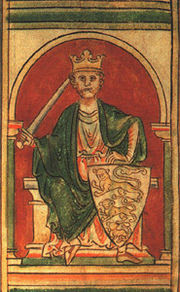

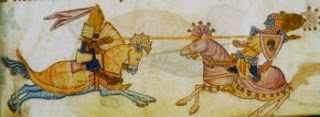
Richard invaded Sicily to settle a dispute within the family, occupied Cyprus, which was to serve as a base for the Crusaders, and then advanced to Jaffa, where he realized that he didn't have the men and weapons necessary to conquer Jerusalem. As this realization sunk in, he sought a diplomatic solution to attain his goals. He parlayed with Saladin, the Kurd who was the Muslim leader, and Al Kamil's uncle. One proposal was that Saladin's brother marry Richard's sister, but Richard's sister would marry no Muslim and Saladin's brother no Christian. It is an irony of history, into which a few undoubtedly read too much, that Saladin and Saddam Hussein shared the same hometown.  In any event, never again has a King of England offered to betroth his sister to a son of Tikrit.  Richard and Saladin agreed that Jerusalem would remain in Muslim hands, but that Christian pilgrims would be free to enter it to visit their holy places, and King Richard began his long (and tortuous) journey home. Richard the Lionheart is not forgotten in the Arab world; because he had several thousand Arab prisoners slain to this day misbehaving Arab children are urged to mend their ways, lest King Richard come looking for them. In England, where Richard spent but a few months of his reign, but let the efficient administration his father had set in place run its course, taxing England to the bleeding point to fund his adventures in the Middle East, his personal bravery is not forgotten. He is remembered as "a bad son, a bad husband and a bad king, but a gallant and splendid soldier."

Frederick II, Holy Roman Emperor, King of Rome, Conqueror of Jerusalem

Another truly interesting historical figures from those days was Frederick II (1194-1250). Among other titles, he was the King of Italy, Germany, Burgundy, Rome and Holy Roman Emperor. Frederick was the scion of a German royal family, that of the Hohenstaufen, his maternal grandfather though, was a Norman.
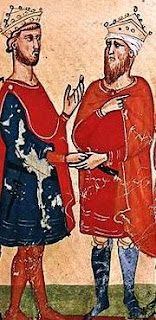
A man of great learning, he was said to speak nine languages, among them Italian, French, German, Arabic, Latin and Greek, and understand another seven; he corresponded with Leonardo of Pisa, aka Fibonacci, one of the greatest mathematicians of his day, founded the University of Naples in 1224 (Thomas Aquinas and Giambattista Vico were alumni), sponsored some of the earliest Italian poetry (in the Sicilian dialect) at his court in Palermo, regulated medical practitioners working in his realms and more. Frederick was known for wearing Arab garb at his court in Sicily, and refusing to expel the Saracens (Arabs) from his domains. In fact, like Francisco Franco, whose bodyguards were Moors, Frederick employed Saracens as his bodyguards; among other advantages, being excommunicated by the pope or the threat thereof worried them not one iota.

Frederick had his problems with the papacy, which at the time was as much a political as a religious institution.  Being the Pope's neighbor all but guaranteed difficulties; one Vicar of the Prince of Peace went so far as to try to have him assasinated. Frederick was excommunicated for delaying his involvement in the crusades, and then embarked on one without the Pope's blessing, which got him excommunicated a second time. After time on Cyprus, Frederick proceeded to the Holy Land, where, rather than fight, - his army was too small anyway - he found himself negotiating with Al-Kamil, who was keen to fight other enemies who he deemed greater dangers. A compromise was reached, Jerusalem but for the Muslim and Jewish holy places was turned over to the Crusaders, as were Bethlehem, Nazareth, and more. It was the first crusade since the First Crusade to be successful, and the first not to end in a bloodbath.

Similarities, and differences, with some contemporary political leaders and their antics may be apparent.


Books: I greatly enjoyed, and highly recommend, Donald Spoto's Reluctant Saint: The Life of Francis of Assisi


AddThis Social Bookmark Button


Wednesday, May 16, 2007

A Spectular Article: A Heart Surgeon Repeats Hippocrates' Observations

Donald Miller, a cardiac surgeon and professor of medicine, has written a spectacular article, The Trouble with Government Grants, which describes just how corrupt, out of touch with reality, often useless and even harmful, what passes for medical research has become.

The bottom line is that the medical discoveries that really serve humanity do not, and have never, come in discrete packets, but have always been due to great minds making breakthroughs. For example, Albert Einstein was working as a patent clerk at the time he rewrote the physics books. The problem when a government puts x amount of dollars into research, is that it attracts second and third rate minds like rotting flesh attracts maggots, is that because such people rarely if ever make huge breakthroughs, and depend on an absence of breakthroughs for their subsistence, what ostensibly is a constituency for medical discoveries rapidly becomes a constituency against medical discoveries.


This is nothing new, here are Hippocrates' thoughts on the matter:


The Law of Hippocrates


MEDICINE is of all the arts the most noble; but, owing to the ignorance of those who practice it, and of those who, inconsiderately, form a judgment of them, it is at present far behind all the other arts. Their mistake appears to me to arise principally from this, that in the cities there is no punishment connected with the practice of medicine (and with it alone) except disgrace, and that does not hurt those who are familiar with it. Such persons are like the figures which are introduced in tragedies, for as they have the shape, and dress, and personal appearance of an actor, but are not actors, so also physicians are many in title but very few in reality.

2. Whoever is to acquire a competent knowledge of medicine, ought to be possessed of the following advantages: a natural disposition; instruction; a favorable position for the study; early tuition; love of labor; leisure. First of all, a natural talent is required; for, when Nature leads the way to what is most excellent, instruction in the art takes place, which the student must try to appropriate to himself by reflection, becoming an early pupil in a place well adapted for instruction. He must also bring to the task a love of labor and perseverance, so that the instruction taking root may bring forth proper and abundant fruits.

3. Instruction in medicine is like the culture of the productions of the earth. For our natural disposition, is, as it were, the soil; the tenets of our teacher are, as it were, the seed; instruction in youth is like the planting of the seed in the ground at the proper season; the place where the instruction is communicated is like the food imparted to vegetables by the atmosphere; diligent study is like the cultivation of the fields; and it is time which imparts strength to all things and brings them to maturity.

4. Having brought all these requisites to the study of medicine, and having acquired a true knowledge of it, we shall thus, in traveling through the cities, be esteemed physicians not only in name but in reality. But inexperience is a bad treasure, and a bad fund to those who possess it, whether in opinion or reality, being devoid of self-reliance and contentedness, and the nurse both of timidity and audacity. For timidity betrays a want of powers, and audacity a lack of skill. They are, indeed, two things, knowledge and opinion, of which the one makes its possessor really to know, the other to be ignorant.

5. Those things which are sacred, are to be imparted only to sacred persons; and it is not lawful to impart them to the profane until they have been initiated in the mysteries of the science.

Ralph Moss, Dean Burk, and Your Precious Bodily Fluids

As previously blogged, Ralph Moss was a PhD working at Sloan-Kettering until he and elements of senior management developed irreconcilable differences of opinion and went their separate ways. After he left Sloan-Kettering, his interest in cancer research undiminished, he befriended Albert Szent-Györgyi, whose theories about and understandings of cancer have already graced this blog.

Ralph Moss also befriended Dean Burk, a biochemist, who, among other things, co-discovered a B Vitamin, played a role in the invention of the MRI, studied with two Nobel Laureates, and more. One of these Nobel Laureates, with whom Dean Burk became an extremely close friend, was Otto Warburg, who also had an extremely interesting life. An MD, a PhD, who won the Iron Cross, second class, and two Nobel Prizes, (unfortunately at the time he won the second, it was considered unGerman to accept a Nobel Prize), a distinguished cancer researcher, whose ideas are coming back into fashion.

Warburg stayed in Germany and kept his job at the Kaiser Wilhelm Institute during the Nazi years despite the fact that his father had been of Jewish origin. The reason for this, the grapevine has it, was that very high-ranking Nazis, if not their leader himself, believed that he was on the cusp of finding a cure for cancer, and wanted to keep him close by, in case they, or their friends or family should need his ministrations. When laws were passed that banned Germany's Jews, and those with a parent of Jewish origin, from its universities, the highest echelons of the Nazi party saw to it that their office responsible for determining racial "purity" "reassessed" Warburg's Jewish background and reported that only one grandparent had been of Jewish ancestry, which, to poisoned minds meant that he was to be left alone. And thus, right to the end of the war, Warburg had a lab wherein he could do his research oblivious to the clash of arms all around him.

One of Burk's passions was the fight against fluoridation. When Dr. John Yiamouyiannis PhD first approached Burk and told him that there was evidence that suggested that adding fluoride to drinking water was an utter catastrophe for public health, Burk all but urged him to get lost, because he'd been at the Kaiser Wilhelm Institute when the initial studies had been done that had concluded that it was safe. Yiamouyiannis dared Burk to examine his data and tell him where he'd gone wrong; Burk did so, agreed that he had to be right, and, convinced that water fluoridation accounts for tens of thousands of deaths per year in the United States, began his crusade against fluoridating public water supplies. Among other accomplishments, he was able to convince the Dutch and Australian authorities to end their fluoridation programs.

Here are Ralph Moss's recollections of Dean Burk.

You may, of course, be asking yourself, why would anyone ever put anything into the drinking water if there is any doubt at all that it is poisonous. The answer is that fluoride is a byproduct of the production of aluminum, uranium and some fertilizers. A few studies and scientists with a distinct whiff of "liars for hire," transformed what would otherwise have been a hazardous byproduct requiring expensive disposal into an expensive asset that the tax-payer in some countries is forced to buy, pay to put into his drinking water, and then ingest.

If you find this hard to believe, watch this incomparable video.

If you want more information, here is a good starting point.

Friday, May 4, 2007

Iran and its Minorities

A while back, I wrote an entry about the tragic life of Mohammed Mossadegh, and mentioned that Iran has a millenia long history of religious tolerance that belies some of the wilder claims made about its government in recent times.

Last week the Christian Science Monitor published an article on Iran's Jews. When the Iranian Revolution began, Iran's Jewish community sent a delegation to the Ayatollah Khomeini, and essentially asked him if they were going to have "problems." He replied that he did not approve of the State of Israel, but that had no bearing on the fact that the Koran enjoined him to tolerate Jews and Christians, and that he had no intention of deviating from the Koran. Many left Iran nonetheless; many of those that stayed reported that they preferred Iran after the Revolution to Iran before the Revolution, when corruption, prostitution, and more had been notoriously widespread. The war between Iran and Iraq, of course, was a tragedy that benefited neither Iran or Iraq.

As the article correctly reports, Iran has reserved seats in its parliament for its Jewish minority, and, if memory serves me right, also for its Christian and Zoroastrian minorities. On the other hand, the Baha'is, who claim to adhere to a new and improved brand of Shi'a Islam, not so unsurprisingly do suffer brutal persecution.

I could not disagree more with some the antics of Iran's current president, which are in exceedingly poor taste; all the same, I feel that it would be disastrous to misreport an unfortunate situation and imply that there is no solution but war. Every country will always have a few nuts, sometimes in high office, but as long as a tradition of tolerance is alive, things are not quite that dire. Perhaps the problem to focus on would be the plight of the Baha'is...

Without further ado, here's the article.


AddThis Social Bookmark Button


Tuesday, May 1, 2007

Lake Van and Aghdamar Island

One of the areas of the world in which I've always wanted to tramp around is the area of eastern Anatolia around Lake Van, Turkey's largest lake and very close to the Iranian border. That area of Turkey has some spectacular archaeological remains, particularly of the Urartians, whose kingdom lasted from the thirteenth to sixth century BC. When their kingdom crumbled, they were succeeded by the Armenians, who were converted to Christianity by the apostles Bartholomew and Jude Thaddeus.

The "Great War" wasn't kind to Van, the largest city on Lake Van, or its inhabitants; many Armenians sided with the Russians against the Turks; the Russians completely destroyed Van; the Turks slaughtered an ungodly number of Armenians; the thousands of Turks held prisoner in Baku by the Russians and Armenians were also smote lest they be freed by the Turks.

In any event, in 915 AD an Armenian king chose to live on Aghdamar; the only building that remains of his palace complex is the Church of the Holy Cross, built in 915-921 AD. For almost 800 years, it served as the seat of the leader of the Armenian Church; everything came to a bloody end in the 1915. In November 2004 a Turkish newspaper reported that Turkish soldiers had recently been using the frescoes in the church for target practice, since then it has been renovated and turned in a museum.

Below are some pictures of Lake Van, Aghdamar Island, and the Church of the Holy Cross.


View of Lake Van


Lake Van on a nice day.


Lake Van - Turkey


AKDAMAR ISLAND AND THE HISTORICAL RUINS ON IT-VAN-TURKEY

Aghdamar Island and Lake Van.


Inside Sourp Khatch (Holy Cross) church on Akhtamar Island, Lake Van

Inside the Church

Adam and Eve on Sourp Khatch (Holy Cross) church on Akhtamar Island, Lake Van

Adam and Eve.

Akdamar entry


Another Picture.


akdamar kabartma_edited

Another picture.


Links
:

More images of the Church of the Holy Cross.


AddThis Social Bookmark Button